
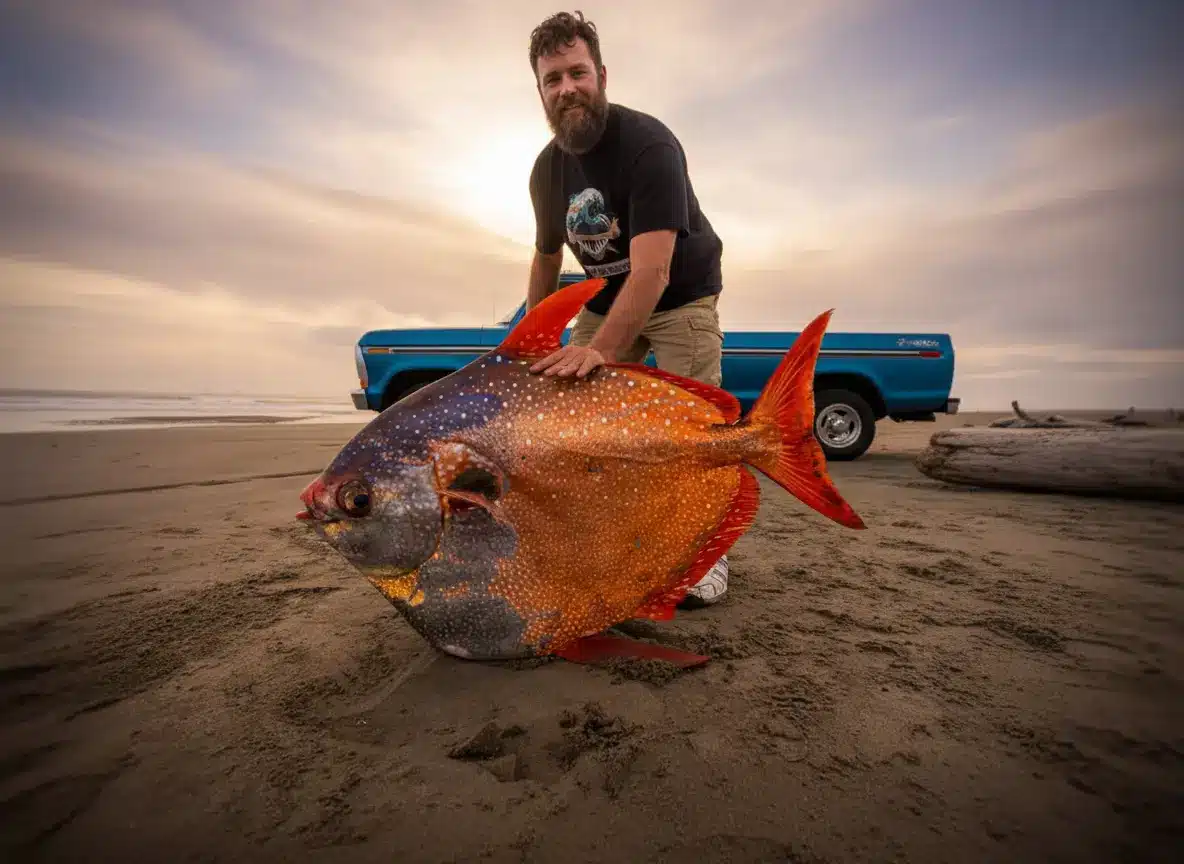
Not every day do you stumble across a 45-kilogram, round-bodied fish glittering with red, orange, and grey scales on your morning walk. But on July 14, 2021, that’s precisely what greeted beachgoers in the small northwest US town of Seaside. And if you’re wondering whether this oceanic visitor left local specialists baffled—you’d be absolutely right.
A Royal Mystery on the Oregon Coast
The star of this peculiar event? A Lampris guttatus, better known as the opah, royal lampris, or moonfish. When this sizeable fish washed up, its presence promptly puzzled the team at the local aquarium. As reported by The Washington Post just a few days later, this species is typically a long way from home. Opahs thrive in much warmer waters than the chilly currents off the Oregon coast; they’re rarely glimpsed in these parts, making their beach debut a hot topic for speculation and delight.
The Institut Français de Recherche pour l’Exploitation de la Mer (Ifremer) notes that this moonfish is usually “a regular inhabitant of tropical and warm temperate seas.” Western Mediterranean sightings are apparently on the rise, which is notable. In France, the opah is seen both near the mainland and farther afield near Mayotte, French Polynesia, and Réunion, as stated by the Muséum National d’Histoire Naturelle de Paris.
From Coast to Coast – and Beyond
The opah has a wide spread, for sure. In the US, the National Oceanic and Atmospheric Administration (NOAA) says the species swims off the East Coast and around US territories in the Pacific—think Hawaii, for instance. But despite these broad oceanic travels, an opah’s appearance in Oregon’s coastal waters remains, as Heidi Dewar of NOAA highlights, a rare event. In fact, the local press, The Oregonian, recounted another opah caught off Oregon in 2009, but that was a notable exception, not the rule.
So, why, might you ask, did this particular opah crash the party in Seaside? The specialists are stumped. Tiffany Boothe, a manager at the Seaside Aquarium, revealed that the fish was discovered in « good condition.” This suggests it died quite close to shore, not after a long oceanic journey or lengthy decomposition. While nobody is wagering bets (at least, not publicly), some experts suspect that climate change—a global party crasher if there ever was one—could be nudging the species into these cooler, less familiar waters.
Unsolved Questions and Unique Features
- Scientists admit they don’t really know what led the opah to the Oregon coast.
- There simply isn’t enough research on the basic ecology or biology of the opah. As one expert put it, “very little research has been done.”
- NOAA even states that there are no existing estimates of the total opah population globally.
The intrigue doesn’t stop there. In 2015, several US researchers published a landmark study on opah, focusing on specimens fished off California’s Pacific coast, as noted in the journal Science. Their findings turned the fish world on its…fins? They discovered that the opah is a warm-blooded fish—the first such specimen identified by scientists. While most fish are stuck with whatever water temperature surrounds them, opahs keep their body about 5°C warmer than the ocean, which is quite the evolutionary trick. Eat your heart out, cold-blooded competitors!
After the Beach – The Opah’s Next Chapter
The Seaside opah won’t just become a curious footnote. To preserve it in its best shape, it’s headed for the freezer. But don’t worry—it’s for science, not supper. According to announcements on the aquarium’s Facebook page, come the new school year, local students may get a hands-on introduction to marine biology. The plan? Dissecting the moonfish to discover more about this mysterious animal, possibly inspiring the next generation of baffled marine specialists, or—if they’re lucky—the next person to find a giant round fish at the beach.
For now, the opah keeps its secrets close to its (warm) chest. One thing’s for sure: the next time you visit Oregon’s coastline, keep your eyes peeled. Because you never know when nature might toss a 45-kilo curveball your way—or, should we say, a moonfish?

John is a curious mind who loves to write about diverse topics. Passionate about sharing his thoughts and perspectives, he enjoys sparking conversations and encouraging discovery. For him, every subject is an invitation to discuss and learn.